
Somewhere in your kitchen there is a yoghurt pot that you rinsed - mine's a Müller Rice (not sponsored).
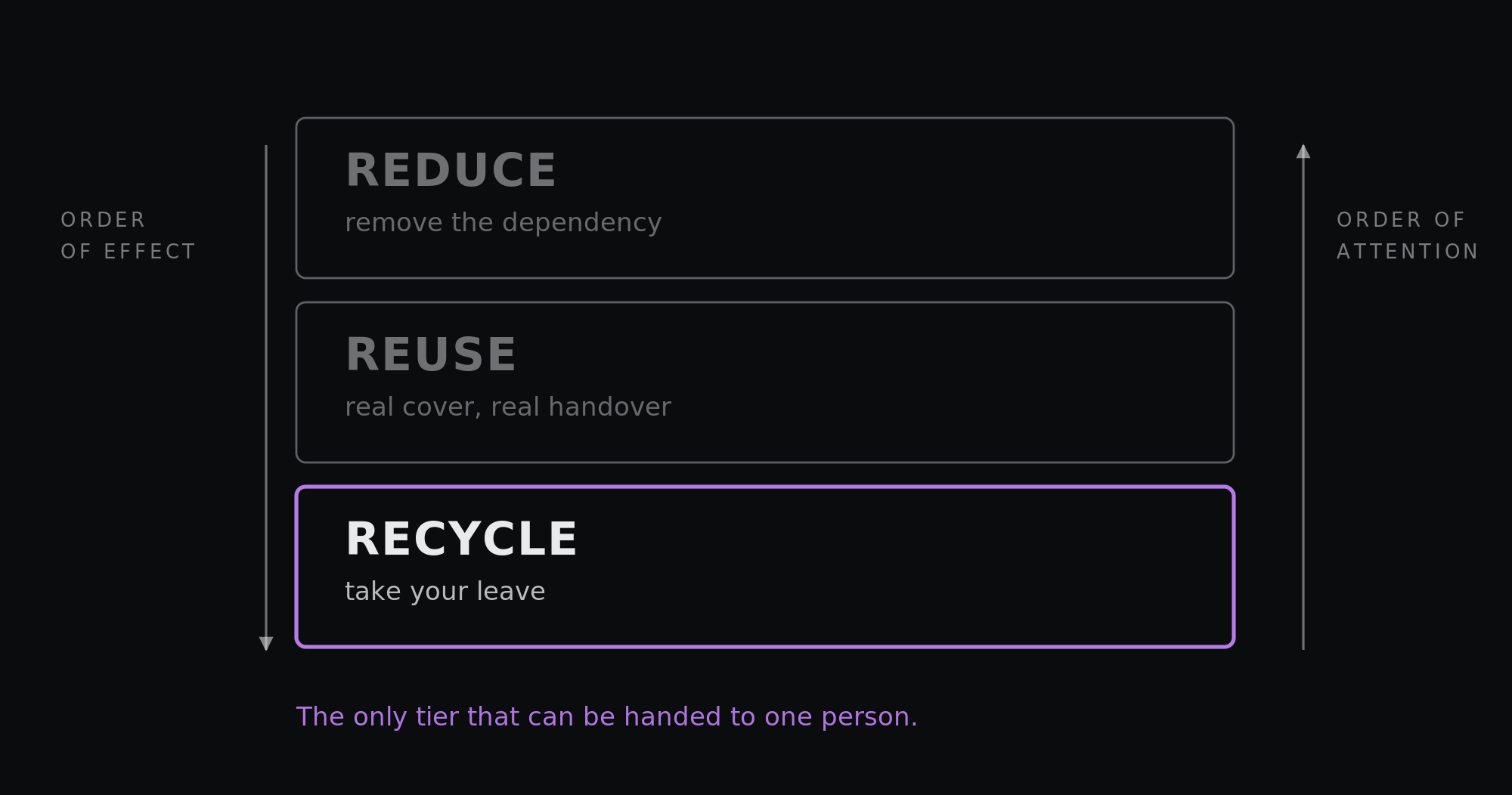
The waste hierarchy is Reduce, Reuse, Recycle, and it is written in that order because that is the order of effect. Recycling comes third. It is also the only one of the three with a bin at your door, a colour-coded lid, a local authority leaflet and four decades of advertising behind it. That is not because it is the most effective intervention. It is because it is the only part of the hierarchy that can be handed to an individual.
Reduce and Reuse are decisions about production. Whether the pot exists at all, what it is made from, whether the thing inside it could have been sold in something refillable, whether the supply chain is built around single-use at all. Those decisions sit with organisations, and organisations found it a great deal more comfortable to give you a box and a rinsing habit than to change their packaging. The genius of it is that it is not even a lie. Recycling is genuinely worth doing, and I am not building towards an argument that it is not. I sort my waste, I rinse the pot, and I would like you to carry on doing the same. My complaint is about ordering, and about who ends up holding the guilt when the system under-performs. It is not about the act.
It is also worth being fair about what may be happening out of sight. Somewhere there are people working on packaging, on materials, on take-back schemes, and I do not doubt that the thinking is going on. The problem is that it almost never arrives as part of the same conversation. What reaches you is the leaflet about rinsing. Whatever is happening upstream stays internal, invisible from where you are standing, and unavailable to you as context for the thing you have just been asked to do.
I have been thinking about that shape recently, because it is the same shape as almost everything we say to people about annual leave. I want to follow it the whole way through, because it ends somewhere practical: with a different question to ask when somebody's leave balance turns up on a risk register.
The individual framing
Take your leave. Protect your work-life balance. Rest is productive. You can't pour from an empty cup. Put your own oxygen mask on first. Book it now, you've earned it.
Every one of those messages locates the problem inside the person. They assume the binding constraint is the individual's willingness, their boundaries, their self-care literacy, their courage. And so the intervention is a nudge: a wellbeing campaign, a reminder from the HR system, a manager asking in a one-to-one whether you've thought about taking some time.
Again, the upstream thinking may well be happening. Resourcing models get reviewed, cover gets discussed, somebody in a planning meeting has raised the dependency out loud. But what lands in the inbox is framed entirely as enablement: here is what we are doing to help you take your leave. The subject of that sentence is still you. Any change to the system, if there is one, arrives dressed as a service delivered to your willingness rather than as a fix to the thing that was actually in the way, and you are left unable to tell which of the two you are looking at.
None of that is wrong, exactly. It is just third on the list, and it is being presented first.
Leave as a risk indicator
There is a version of this that shows up in my professional world rather than the pastoral one. Unused leave is a risk signal, and a well-established one. Financial services have required mandatory block leave for decades, not out of kindness but as a fraud detection control: schemes that need continuous tending tend to fall over when someone else sits at the desk for two weeks. More broadly, a person who never goes away is a key-person dependency and a single point of failure. If the only thing keeping a service running is one individual's unbroken attendance, you do not have a resilient service, you have a person.
So leave shortfall does turn up on risk registers and in resourcing reviews. What interests me is what happens next. Almost always, the finding is about the person, and so the treatment is aimed at the person. A conversation. A mandated block booking. A gentle enquiry about whether everything is alright at home.
That is the recycling box again. It is a response pitched at the last and cheapest point of the chain, offered to whoever is standing at the end of it.
Some people genuinely do lose track
Plenty of people surface in October, look at a balance they have not thought about since January, and get a genuine shock. Work is absorbing, the year is long, and a leave balance is not the sort of running total everybody keeps. For those people the reminder is exactly the right intervention and it works, and I am not going to pretend otherwise.
But a reminder only fixes the cases where forgetting was the whole cause. When the same names come round every year, or when someone books the time and then quietly hands it back, forgetting is not what you are looking at. Leave shortfall is a downstream indicator, and past a certain point the interesting question is what sits upstream of it.
What sits upstream
The obvious one is cover, or the absence of it, and I am going to come back to that because it is mine.
Cover is not a binary, either. Naming somebody as your cover requires that you have the authority to name them, that they have the authority to act once named, and that you are reasonably confident they will act rather than hold everything until you get back.
I want to be careful here, because the obvious reply is that a placeholder beats an unstaffed gap, and most of the time it does. Somebody has to answer the phone.
The failure is more specific than delay. It is what the delay does to the information. A client who has already walked somebody through their environment reasonably believes they have given everything, so going back a fortnight later to ask again is expensive, socially as much as commercially. If the cover set scope without the context, or made commitments that the returning person then has to unpick, or simply did not record enough for anybody to pick the thread up again, the gap has not been held open. It has been closed badly. An open gap gets rescheduled. A badly closed one gets signed off, and the delivery team inherits a scope inside which they cannot do their best work, however good they are.
In cyber-physical work that stops being a commercial irritation quite quickly. Once health and safety sits inside the scope, once there are RAMS to agree and physical processes that a test can perturb, a scoping decision taken without the right context is no longer only a delivery problem. It becomes an organisational one.
All of which bites hardest exactly where it matters most, because a single point of failure is a single point of failure precisely when the context, the relationships and the judgement have accumulated in one place. The thing that makes the handover necessary is the same thing that makes it feel unsafe to attempt.
Some of it is fear rather than logistics. You are afraid the work runs fine without you. Or you are afraid that it does not, and that the failure gets attributed to your absence rather than to the resourcing decision that made your absence load-bearing.
Then there are the ones nobody says out loud. Being new, or on probation, or on a performance plan. Being the person whose visa or job security makes visibility feel mandatory. Working somewhere that measures utilisation or billability, where every day of leave is arithmetic against a target you are appraised on. Watching senior people answer messages from an airport and correctly reading that as the actual policy, whatever the written one says.
Not one of those is fixed by being told that rest is productive.
I am one of them
I should be straightforward about the fact that I am describing myself here, not a system I observe from a safe distance.
My case is not typical, and I am using it deliberately for that reason. Edge cases are diagnostic. If you want to know where a line of reasoning ends up, you run it against the condition it was not designed for and see what gives way. Individual-responsibility messaging is built for the person who has ordinary work, ordinary cover and an unhelpful habit. Running it against someone whose role is deliberately spread across delivery, pre-sales and technical assurance shows you what the messaging quietly assumes.
On paper my role is a delivery one. Billable days, utilisation, the kind of measure that turns a week of leave into simple subtraction. In practice I wear several other hats, because being the subject matter expert for cyber-physical systems, for research-led approaches and for a certain amount of the AI work means I am also in the pre-sales conversations and the account management ones. I sit on the scoping side often enough to know precisely how work gets sold badly, and how difficult scoping is to do well even when everyone involved is competent and trying hard.
I want to be careful with the phrase badly scoped, because it does not mean the customer got nothing. Some of the best engagements I have been part of were ones where the scope turned out to be wrong, because the wrongness was the finding. Cybersecurity work is largely transactional and fixed price, which is a sensible way to sell a known quantity and a poor way to sell an exploration. Often the customer cannot scope it accurately because they do not yet hold the information required to do so, and the honest shape of the work is discovery. Those engagements are frequently more valuable than the one that was originally asked for. They also demand a different delivery mindset and far more careful expectation management, because a discovery outcome does not fit the mental model that still dominates the market: a test happened, nothing exploded, therefore we are fine.
The failure I am pointing at is not the gap being found. It is the gap being found with no room left in the commercial envelope to do anything with it, so somebody absorbs it in their own hours, quietly, and the system records a clean success.
That absorption is the thing I find hard to be away from. I have been the person who inherits a badly scoped engagement and makes it land anyway, with more effort and more hoops on delivery than anyone budgeted for. I have been praised for doing it. It does not feel good at the time, and I read it as a failure of the system rather than a personal triumph. So I would much rather be present when the scope is set than be the reason a colleague has to do that later.
When I am off, the direct steer goes with me, and so does the indirect steer through technical QA. Often enough something slips the net while I am away and is waiting for me when I get back. That is not a comment on my colleagues, who are perfectly capable of covering. It is that my particular mix of engineering, testing and research lets me straddle a set of things that are normally split across several people, and every time I straddle them I make myself a little more of the single point of failure I would flag on anybody else's risk register.
That last sentence is the whole argument in miniature. The behaviour that makes me useful is the behaviour that makes me a dependency, and no amount of encouragement to look after myself touches it. What touches it is scoping quality, QA that does not route through one person, and enough slack in the model for somebody else to be the one who straddles.
Where I part company with the balance framing
There is a version of this argument that runs on the sanctity of the boundary between work and life, and I should say plainly that it is not mine.
I hold no illusions about the social contract between employers and employees, or about which direction the value flows under the current arrangement. It is not a fair deal and I am not going to pretend it is. But I do not experience my work and my life as two separate territories with a fence down the middle. The work I do is mentally stimulating in a way that keeps me level, and that is not a small thing: it is a significant part of what holds depression at arm's length. It gives me problems worth chewing on, people worth arguing with, and a reason to be interested in the day. Without it I do not think I would have much of a life, and I mean that as a description rather than a tragedy.
People react oddly when I say that. Usually with a gentle sort of dismissal, as though I have said something I will be embarrassed by later, or as though the statement is itself a symptom and a sufficiently rested version of me would retract it. I do not think it is. Some of us are not asking for less work. We are asking for work that is scoped, resourced and supported well enough that going away for a fortnight is not an act of sabotage against our own future selves.
Which is precisely why I want this argument to rest on system design rather than on the moral status of rest. If the case for taking leave depends on believing that work is the thing you escape from, it does not reach people like me. And people like me are the ones showing up on the risk register.
What psychological safety actually asks
Psychological safety gets used loosely enough that it has started to mean "being nice", which is a shame, because the original idea is sharper than that. It is about whether the environment makes a particular behaviour survivable. The question is not "do your people feel able to take leave", which will get you a survey score and nothing else. The question is "what actually happens here when someone is away".
That one you can test, and it is answered by evidence rather than sentiment. Who covers this person, by name. Has that cover ever been exercised, or does it exist only in a spreadsheet. Can the cover actually decide, or only hold things until the person is back. What happened to the workload of the last person who took a fortnight: was it absorbed, or did it wait for them on a shelf. How many people contacted them while they were off, and what was the seniority of the most senior one. Does the person who books leave have to negotiate for it, or apologise for it, or find their own cover first.
If leave-taking is the recycling, then this is the Reduce and Reuse. Reduce the single points of failure: cross-train, document, rotate the work that only one person knows. Reuse the capacity you already have: real cover with real handover, with the handover time budgeted rather than treated as a favour extracted from someone else's week. Those are organisational decisions, they cost money and planning attention, and they are the only ones that move the number.
Where the analogy breaks, and why that helps
The recycling comparison has a limit, and the limit is the useful part. I should not overstate the individual's powerlessness upstream, because it is not true that rinsing is the only act available. Deposit return exists. Pfand works, and it is worth pausing on why it works: it restructured the transaction rather than applying pressure to anybody. Refillables, glass return schemes, buying from the businesses that take their own packaging back and voting for the regulations that make any of it mandatory are all genuine routes into the Reduce and Reuse end of the hierarchy. They are just collective, slow, and available to you as a consumer or a citizen rather than as the person standing at the bin. And not one of them is what the leaflet asked you to do.
At work the routes are closer and much more specific. You are inside the organisation already, and you are not aggregating your preference with several million other people in the hope of shifting a market. The person who has not taken leave is usually the person who can tell you most precisely why. They can name the dependency. They know which parts of the handover have never been written down, which of their tasks only appear to require them, and which genuinely do. That is diagnostic information the organisation cannot obtain any other way, and it happens to be sitting with the person the wellbeing campaign was aimed at.
Which makes a conversation available that recycling never offers. Take the leave, and when you are back we are opening a review of how cover actually works here, and you are in it. That does two useful things at once. It makes the upstream work visible instead of leaving it internal and unseen, so the person can tell the difference between a fix and a nudge. And it treats them as a source of evidence rather than as the object of an intervention, which is the only version of this I have ever heard that does not feel like being managed.
The strongest objection
The obvious counter is that individual agency is real, and it is. Some people do have workable conditions and unhelpful habits. Some genuinely need to hear that it is permitted. Encouragement costs nothing, so encourage away.
But do not mistake it for a control. The test I would apply is the one I would apply to anything else in an assurance argument: what would change if the intervention failed. If the answer is "we would say we ran the campaign, and the person still hasn't booked anything, so it's on them", then the intervention was never doing the work. It was producing an artefact and a moral remainder, and the remainder lands on the individual, who now gets to feel personally deficient about a constraint they did not create and cannot remove on their own.
That is the part that unites the two stories. The person rinsing the pot is doing something reasonable and has been handed the guilt for a decision taken several tiers above them. The routes they have to that decision are real, as deposit return demonstrates, but they are collective and slow and none of them are on the leaflet. The leaflet is about the rinsing, and so is the shame.
The ones the numbers do not show
Most readers will not have my particular shape. But nearly every organisation has somebody who does, and the awkward thing about the shape is that it tends to be invisible to the view most likely to be looking.
Businesses protect their revenue-generating activity, and they generally work the biggest number first. Given the objective, that is coherent rather than negligent, and I am not going to pretend to be surprised by it. I would not do the same, though. I have argued before that behind every metric and every risk disclosure there are people, and that a system which only ever works the number will drop them the moment they stop reading as one. Structural dependency and revenue visibility are not the same axis. The people who hold things together across engagements rather than inside one are frequently not attached to a large number of their own. Their contribution is spread thinly through other people's work, and a good deal of it is preventative, which means it registers as an absence of problems. An absence of problems does not appear in a pipeline report.
So the person who is a genuine single point of failure can also be the person nobody has flagged, because the two views of them disagree. The risk register knows exactly what they are. The revenue view does not really see them. If protective attention follows the biggest number, and it usually does, that gap is precisely where it will not be pointed.
So if someone on your team shows up as risky because they have not taken leave, send the reminder. Some of them did just lose track of the year, and it will do the job. For the ones where it does not, go and look at the environment they are declining to leave, and ask what makes staying the rational choice.